A house of worship AV system has one non-negotiable job: every person in every seat must hear and see clearly. That sounds simple, but getting there in a real sanctuary — with hard reflective surfaces, balconies, side wings, and a congregation spread across 50 to 1,500 seats — takes acoustic design, proper speaker selection, careful DSP tuning, and experience with the unique demands of live worship. We have designed and installed house of worship AV systems for faith communities throughout Raleigh, Cary, Durham, and the Triangle, and the gap between a well-designed system and a poorly specified one is enormous.
Here is what professional church AV actually involves, what it costs, and what to look for when choosing an installer.
The Three Pillars of a Church AV System
Every house of worship AV system has three core components that have to work together. Weakness in any one of them shows up immediately in Sunday service.
1. Sound System: Intelligibility First, Volume Second
The most common complaint we hear from congregations is not “it’s not loud enough” — it is “we can’t understand what is being said.” Intelligibility is the technical measure of how clearly speech is understood, and it is determined by speaker placement, coverage angle, room acoustics, and DSP processing — not by turning up the volume.
For most sanctuaries, one of two speaker configurations delivers consistent intelligibility across every seat:
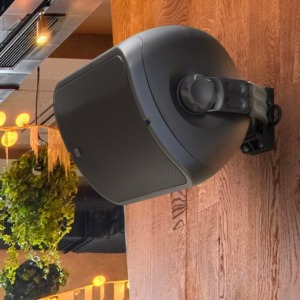
- Distributed cluster system: A center cluster of two to four speakers aimed at different zones of the congregation, combined with delay speakers under a balcony if one exists. Works well in lower-ceiling rectangular rooms.
- Line array system: Vertical columns of drivers that control sound dispersion precisely, throwing clean audio to the back of the room without blasting the front rows. The right choice for larger, higher-ceiling sanctuaries and contemporary worship spaces with live bands.
We specify JBL Professional and Yamaha Pro speakers frequently — both have excellent intelligibility ratings and long-term reliability in demanding weekly-use environments. QSC and Crown amplifiers are our standard for amplification; they are built for continuous professional use, not occasional home party duty.
2. Microphones: The Source Matters as Much as the Speakers
No speaker system can fix a bad microphone signal. For most churches, the mic package includes several types used simultaneously:
- Wireless handheld: For pastors and speakers who prefer holding the mic. Shure ULXD and QLX-D systems are the standard for professional wireless in worship environments — they frequency-hop to avoid interference from neighboring churches and events.
- Wireless lavalier (bodypack): Clip-on mic worn on the collar or lapel. Gives freedom of movement; critical for preachers who walk the stage. Requires a skilled volunteer audio operator to manage gain, since the mic-to-mouth distance varies with head movement.
- Podium/pulpit condenser: A gooseneck condenser mounted on the lectern for liturgical readers or guest speakers who may not be comfortable with a wireless pack.
- Choir and stage mics: For contemporary worship bands, overhead condenser mics (AKG, Audio-Technica) over the choir, plus direct instrument inputs and stage mic lines for vocalists and instruments.
We also design the stage box and snake infrastructure so new wireless channels can be added later without rewiring the entire stage — this matters because most churches add channels as their ministry grows.
3. Digital Mixing Console: Where It All Comes Together
The days of analog consoles with 24 faders and a wall of knobs are fading. Digital consoles like the Yamaha TF and CL series or QSC TouchMix allow volunteer operators to call up scenes for different service formats, store EQ and effects, and recall the exact settings from last Sunday in seconds. For churches that rely on volunteers (which is most of them), that repeatability is critical — you cannot expect a volunteer to rebuild the perfect Sunday sound from scratch every week.
We also specify a separate monitor console or digital personal mixing system for the stage when the worship team needs in-ear monitors (IEMs). The Aviom and Hear Technologies personal monitor systems let each musician control their own mix from a belt pack, reducing stage volume dramatically and giving the congregation a cleaner, controlled listening environment.
Planning a Church AV Upgrade in Raleigh?
We design systems around your sanctuary size, congregation, and worship style — not a template. Schedule a free consultation and we will walk you through what a properly designed system looks like for your space.
House of Worship AV ServicesVideo: Screens, Projection, and LED Walls for Sanctuaries
Once the sound system is right, video is the next priority. Lyric projection, sermon notes, scripture references, and live camera feeds of the stage are now baseline expectations for contemporary and traditional congregations alike.
Projection vs. LED Video Wall
The choice between a projector-and-screen setup and an LED video wall comes down to three factors: room lighting, budget, and the long-term total cost of ownership.
- Projection: Lower upfront cost. A 10,000-lumen laser projector on a large motorized screen (120”–160”) serves most mid-size sanctuaries well and delivers a large image at a fraction of the cost of an LED wall. The trade-off: projectors depend on controlled ambient light, and laser lamp assemblies eventually need replacement after 20,000+ hours. We lean toward Sony and Epson professional laser units — they handle long lamp life without the color shift that plagued older lamp-based projectors.
- LED video wall: Dramatically brighter than projection, works in any ambient light, and has no consumable lamp to replace. The upfront cost is higher — a 16’×9’ fine-pitch LED wall runs $40,000–$80,000 installed — but for a church using the space daily and projecting in a bright modern building, the operational advantages add up. We have installed LED video walls for Raleigh-area churches and the visual impact on stage presentation is significant.
IMAG (Image Magnification) Camera Systems
For larger congregations, image magnification — live camera feeds of the speaker or worship leader displayed on the sanctuary screens — bridges the gap between front-row and back-row experiences. PTZ (pan-tilt-zoom) robotic cameras controlled from the booth are ideal for churches with small volunteer teams: a single operator can manage three to four camera angles from a single controller, cutting and switching without requiring camera operators on the floor.
We integrate camera signals with the video switcher, presentation software (ProPresenter is the worship industry standard), and any confidence monitors on stage so the speaker can see what is on the screen without turning around.
Livestreaming: Reaching Your Congregation Beyond the Building
If your church is not livestreaming, you are missing a significant portion of your community — members who are traveling, homebound, or simply unable to attend in person. A properly designed livestream package involves:
- A dedicated program audio feed from the digital console, EQ’d specifically for streaming (streaming mixes are brighter and more compressed than room mixes)
- A streaming encoder (hardware units from Blackmagic Design or software encoders on a dedicated PC)
- Camera feeds from one to three PTZ cameras
- A broadcast switcher (ATEM Mini Pro is a popular affordable entry point; Roland V-8HD for larger productions)
- Reliable high-upload internet infrastructure, ideally a dedicated circuit separate from the congregation’s guest WiFi
We design the livestream system so it can run with a single volunteer — the last thing your team needs on Sunday morning is a complicated multi-operator production workflow. We also run network infrastructure correctly so the streaming signal has guaranteed bandwidth separate from your congregation’s phone traffic.
Hearing Assistance Systems
The Americans with Disabilities Act requires hearing assistance systems in most public assembly areas, including houses of worship. There are three options:
- Hearing loop (telecoil/T-coil): A wire loop installed under the floor or around the perimeter of the sanctuary that broadcasts audio directly to hearing aids equipped with a T-coil. No receiver required for users with compatible hearing aids — they simply switch to the T-coil setting. This is the most seamless experience and the option we recommend when feasible.
- FM assistive listening: A transmitter broadcasts the audio mix on an FM frequency; users check out a small receiver and headset. Simple and affordable, but requires managing a pool of receivers.
- Infrared (IR) assistive listening: Similar to FM but uses infrared light rather than radio frequency, which keeps the signal within the building. Preferred in facilities where confidentiality is a concern or where RF interference is an issue.
Acoustic Treatment: The Factor Most Churches Skip
No AV system can overcome a severely reverberant room. Many sanctuaries — especially older stone or brick buildings, or newer buildings with hard parallel walls, tile floors, and high ceilings — have reverberation times of three to five seconds. In a room that reverberant, even the best speakers will produce muddy, indistinct speech.
Acoustic treatment does not mean covering every wall in ugly foam panels. Strategic placement of fabric-wrapped absorption panels, bass traps in corners, and occasionally diffusers on rear walls can reduce reverberation to the 1.0–1.5 second range that most sanctuaries need for comfortable speech intelligibility. We work with acoustic consultants when a space requires serious treatment and can recommend practical options that maintain the aesthetic character of the room.
What Does a Church AV System Cost in Raleigh?
Here is a realistic cost breakdown for Triangle-area faith communities:
- Small sanctuary upgrade ($15,000–$40,000): 100–300 seats. Digital mixer, two to four main speakers, subwoofer, four to six wireless mic channels, and basic video projection. This tier handles a well-designed refresh of an underperforming system without a full gut-and-replace.
- Mid-size church system ($50,000–$120,000): 300–800 seats. Line array or large cluster speaker system, digital consoles for front-of-house and monitors, eight to twelve wireless channels, projection or mid-size LED video wall, basic camera system, and hearing loop. The system most growing Raleigh and Cary congregations fall into.
- Large facility / full integration ($150,000–$300,000+): 800+ seats or multi-campus facilities. Custom line arrays, large-format LED video wall, full IMAG camera system with PTZ automation, integrated livestream workflow, overflow room distribution, and fellowship hall zoning. This is a complete AV infrastructure build, often phased over two to three budget cycles.
We design to your budget and prioritize the elements that matter most for your congregation and worship style. A contemporary church with a live band has very different needs than a traditional liturgical congregation — we do not apply a one-size-fits-all template.
What to Look for in a House of Worship AV Installer
The quality of the design and installation matters as much as the equipment you purchase. A few things to look for:
- Worship AV experience specifically: Church installations have unique challenges — volunteer operators, weekly high-stakes use, acoustic complexity, and competing needs from different ministries — that differ from office or restaurant AV. Ask for references from other faith communities.
- Acoustic design capability: An installer who cannot address room acoustics will over-specify equipment to compensate, which costs more and still delivers a mediocre result. Ask how they approach speech intelligibility measurement.
- Training and documentation: Your volunteer operators need to be able to run the system confidently every week, not call for support after every service. Ask what training and documentation are included in the project.
- Long-term support: What happens when something fails on Saturday night? Ask about service agreements and emergency response.
We provide thorough volunteer training, system documentation, and ongoing support for every house of worship project. We also design systems to be operable by non-technical volunteers — scenes are named clearly, critical functions are obvious, and the advanced settings that could cause problems are secured behind a technician-level password.
Frequently Asked Questions
How much does a church sound system cost?
A modest upgrade for a smaller sanctuary — new speakers, a digital mixer, and wireless microphones — typically runs $15,000 to $40,000 installed. A mid-size church with line array speakers, multiple wireless channels, in-ear monitors for the stage, and a front-of-house console runs $50,000 to $120,000. Larger facilities with custom line arrays, full video integration, and livestreaming infrastructure can exceed $200,000. We design to your congregation size and budget.
What is the best speaker system for a church sanctuary?
For most sanctuaries, a properly aimed line array or cluster speaker system delivers even coverage without the hot spots and dead zones you get with older systems. JBL Professional and Yamaha Pro are both strong choices with excellent intelligibility. The speaker selection matters less than the design — coverage angle, delay timing, and DSP tuning are what make speech clear in every seat, not the brand logo on the cabinet.
Can you set up live streaming for our services?
Yes. We design and install complete livestream packages — dedicated camera feeds (PTZ robotic cameras are popular for lean volunteer teams), a streaming encoder, and direct integration with your existing audio console. We can route a clean program mix to your streaming platform of choice without requiring a separate audio operator.
Do you handle projector and screen installation for churches?
Yes. We install projection systems, LED video walls, and motorized screens for sanctuaries and fellowship halls. We size the screen to the room, position it correctly relative to the stage, and integrate it with your presentation or lyrics software.
How do you handle hearing assistance for congregation members?
We install hearing loop (telecoil/T-coil) systems and FM/infrared assistive listening systems. Hearing loops are the most seamless option because they work directly with hearing aids that have a T-coil setting, requiring no additional receiver for the user.
Do you serve churches outside of Raleigh?
Yes. We serve faith communities throughout the Triangle, including Cary, Apex, Durham, Wake Forest, Chapel Hill, Morrisville, and surrounding areas in Wake and Durham counties.
Ready to Upgrade Your Sanctuary AV?
We serve faith communities across Raleigh, Cary, Apex, Durham, Wake Forest, Chapel Hill, and the entire Triangle. Contact us to schedule a free site consultation — we will walk your space and put together a realistic plan and budget.