Almost every Raleigh homeowner we meet has the same clutter problem, even if they have never described it that way: a streaming stick behind one TV, a cable box under another, a different remote for each, and a kid who cannot figure out why the upstairs TV does not have the same app as the one downstairs. Whole-house video distribution solves this by moving all the source equipment into one rack in a closet and sending video to every TV in the house over the same Cat6 cabling already running your network. Each room still picks whatever it wants to watch — it just does not need its own box to do it.
We design and install these systems as part of our home theater and home automation work across Raleigh, Cary, Apex, and the Triangle. Here is how the technology actually works, when it is worth the investment, and what it costs.
How Whole-House Video Distribution Actually Works
The concept is simple even though the engineering behind it is not. Instead of a streaming box, cable box, or 4K player sitting under every television, all of the source devices live together in a single equipment rack — typically in a closet, basement mechanical room, or media closet. Each source connects to a small transmitter, and each TV connects to a small receiver. Both talk to each other over the home's Cat6 network using HDMI-over-IP technology (we most often spec WyreStorm NetworkHD or a comparable managed platform), so any TV in the house can pull video and audio from any source, on demand, at full 4K with HDR.
The practical result: a single Apple TV, cable box, or media server in the rack can be watched in the kitchen, the primary suite, and the basement simultaneously — each room controlling its own channel or app independently, with no picture lag and no shared "everyone watches the same thing" limitation people often assume matrixed video means.
What You Actually Get Day to Day
- One set of source equipment for the whole house. Buy one Apple TV, one cable box, one 4K Blu-ray player, and every room can access it — instead of buying and maintaining a box for every television.
- True independence between rooms. The primary suite can stream a movie while the kitchen has the morning news on and the basement is watching a game — all from a shared pool of sources, all controlled separately.
- One remote or app for the entire house. Instead of learning which remote goes with which TV, every room uses the same interface to pick a source and adjust volume.
- Easy source upgrades. Add a new streaming device or swap out an aging cable box once, in the rack, and it is instantly available to every TV in the house — no re-wiring, no visiting every room.
- Clean rooms. No box, no cable clutter, and no extra remote sitting under or beside the TV. Just the television and, if the room has one, a slim in-wall keypad or touchpanel.
Tired of a Different Remote at Every TV?
We design whole-house video systems that put every source in one rack and every room on one remote. Serving Raleigh, Cary, Apex, Wake Forest, and the entire Triangle.
Explore Home Theater & VideoIs It Worth It, or Should You Just Buy a Streaming Stick for Every TV?
We get asked this honestly and we give an honest answer: for a one- or two-TV home, a Roku or Apple TV on each set is perfectly reasonable, and we will tell a client that rather than sell them a system they do not need. Whole-house distribution starts earning its cost once a home has four or more TVs and any of the following are true:
- You want one app or remote controlling every TV instead of five different interfaces
- You have a live cable, satellite, or IPTV feed you want available in multiple rooms without paying for a receiver at each one
- You want a 4K media server, security camera feed, or specialty source (a sports package box, a gaming console) accessible from any TV in the house
- You are already investing in whole-home automation and want video control unified with lighting, shades, and audio
Where it is not the right call: a guest bedroom or a home with just one or two televisions. We would rather spec a $50 streaming stick there and put the budget toward a system that actually gets used.
Bringing It Together With RTI
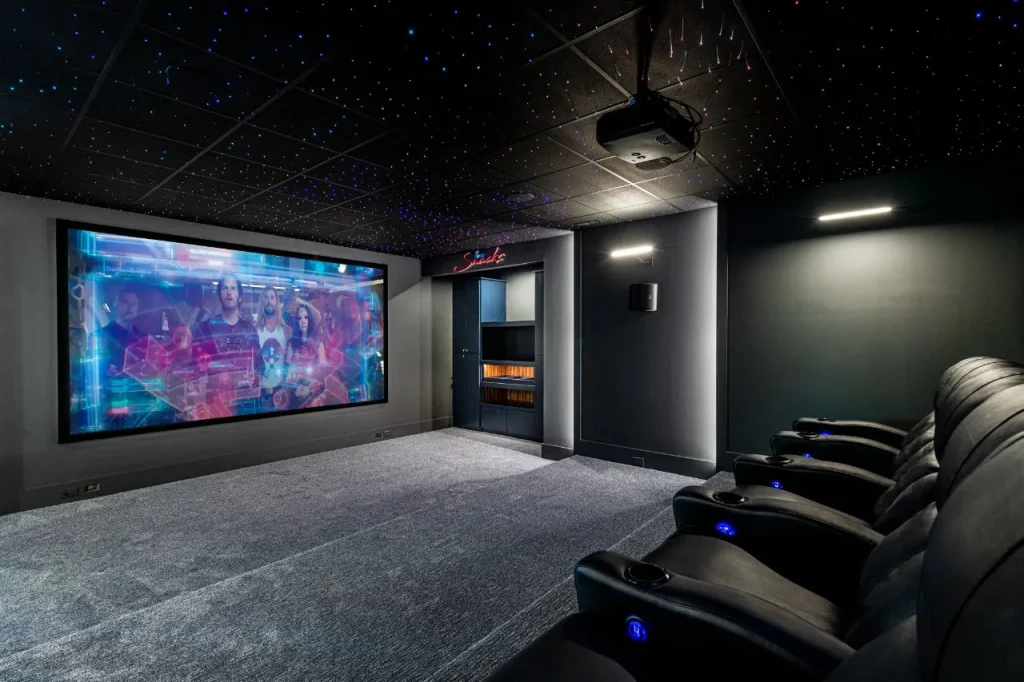
Video distribution is at its best when it is not a separate system you think about — it is one tile on the same remote controlling everything else. In the RTI systems we design, room and source selection for video lives right alongside lighting scenes, shade positions, and whole-house audio. Pull up "Movie Night" in the theater and the system selects the right source, drops the shades, dims the lights, and switches the projector input in one tap. Select "Kitchen TV" from a wall touchpanel and it shows exactly which sources are currently available in that room. It is the difference between a house full of separate gadgets and one system that actually behaves like it was designed together.
New Construction vs. Retrofitting an Existing Home
Timing changes the scope and cost significantly. During new construction or a major remodel, we run home-run Cat6 cabling from a central equipment location to every TV location while walls are open — the same trip that pulls speaker wire, network drops, and camera cable. Adding video distribution at that point is a modest incremental cost on top of cabling that is already happening.
Retrofitting an already-finished home is still very achievable. In most cases we can fish Cat6 through existing walls and attics to reach each TV location, particularly where a home already has some structured wiring infrastructure in place from a prior project. Homes with finished walls and no accessible attic runs sometimes need a hybrid approach — wired to the TVs we can reach cleanly, with a standalone streaming box at the one or two locations where running cable is impractical.
What Does Whole-House Video Distribution Cost in Raleigh?
Costs scale with the number of TVs (endpoints) and source devices, not the size of the house itself:
- 4-TV system, shared sources: $6,000–$12,000, including the rack equipment, transmitters, receivers, and cabling for four rooms sharing three to four sources.
- 8-TV whole-home system: $14,000–$24,000, typically paired with RTI control for one-app operation across the house.
- 12+ TV system with full home automation integration: $25,000–$45,000+, usually bundled into a broader whole-home automation project covering audio, lighting, and shades alongside video.
- New construction Cat6 prewire for video (per TV location): Adds a modest per-drop cost when run during framing alongside your other structured cabling — a fraction of what the same run costs after drywall.
The single biggest cost driver is not the video equipment itself but the cabling infrastructure, which is exactly why we always evaluate video distribution at the same time as whole-house audio planning — running both during the same construction phase saves real money over doing them as separate projects later.
Frequently Asked Questions
What is whole-house video distribution?
It is a system that shares video sources — a streaming box, cable box, or 4K player — from one central equipment rack to any TV in the house over Cat6 cabling, so each room can watch a different source without its own dedicated box. It is controlled from a single remote or app instead of juggling separate remotes at every television.
Can every TV really watch something different at the same time?
Yes, as long as the system has enough source inputs for the number of simultaneous streams you want. A typical whole-home system might have six to eight source devices feeding twelve or more TVs, and any TV can independently select any available source at any time.
Isn't it simpler to just put a Roku or Apple TV on every television?
For a one- or two-TV home, yes, and it is often what we recommend. Whole-house distribution earns its cost once you have four or more TVs, want a single app or remote to control all of them, need to share a live cable or satellite feed to multiple rooms, or want a 4K source available anywhere in the house without buying a box for every room.
Does whole-house video distribution work with 4K and HDR?
Yes. Modern HDMI-over-IP distribution handles 4K at 60Hz with HDR over standard Cat6 cabling, which is why the cabling plan matters just as much as the equipment. We size the network switches and cabling for full 4K bandwidth from day one so the system does not need to be redone when you upgrade a TV.
Can I control whole-house video from my RTI system?
Yes — this is one of the most-used features in the RTI systems we design. Source and room selection, volume, and playback all live on the same remote, touchpanel, or phone app used for lighting and shades, so watching the game in the kitchen while the kids stream a movie upstairs is a couple of taps, not a hunt for the right remote.
Ready to Simplify Every TV in Your Home?
We design whole-house video systems for Raleigh, Cary, Apex, Wake Forest, Durham, Chapel Hill, and the entire Triangle. Contact us for a free consultation and a realistic scope for your home.